Monday, 30 October 2017

Thursday, 26 October 2017
Research - Focus Group Feedback

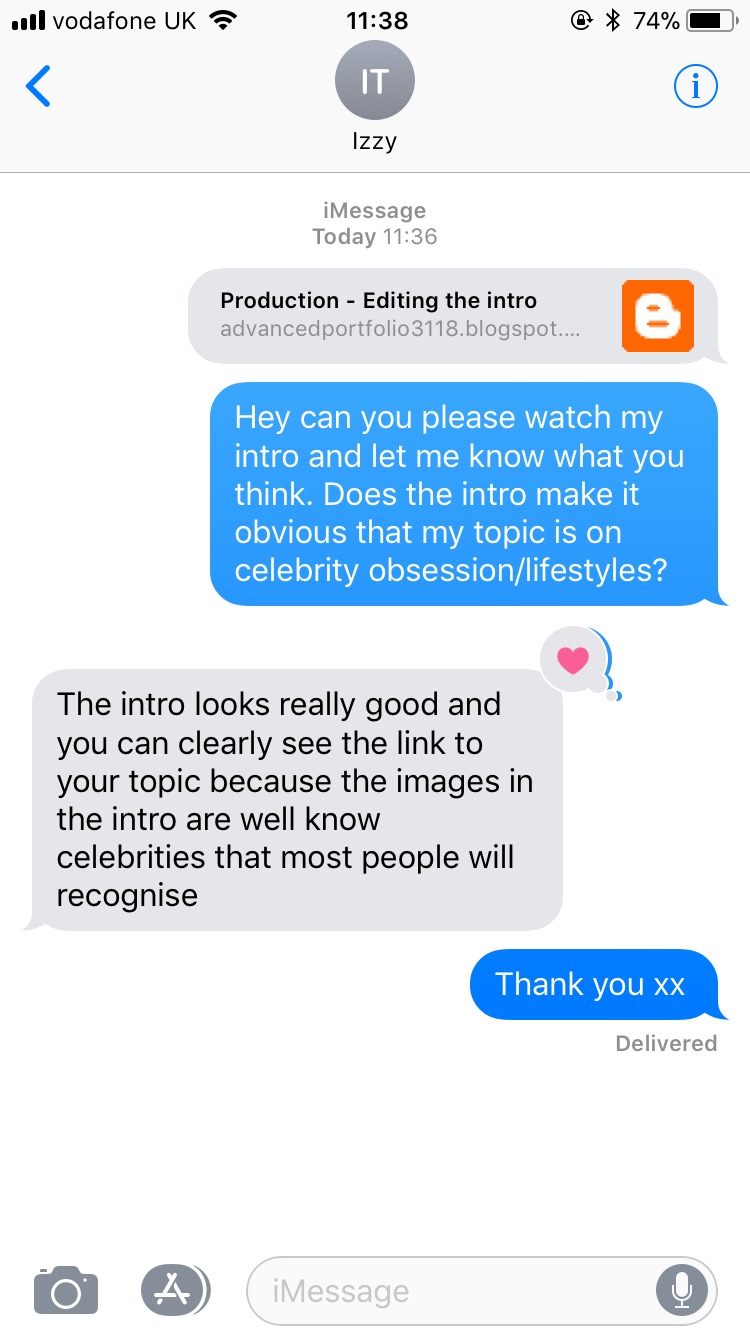
I messaged some of the members from my focus group in order to get their opinion on my opening sequence/intro. The feedback I received was extremely useful in helping me see that my target audience were able to easily link the images from my opening sequence to my topic of celebrities. In addition to this, I also received some helpful advice on how to improve by repositioning the last photo in my sequence so that it flows better and looks more aesthetically pleasing.
Tuesday, 24 October 2017
Production - Editing Interview

After re-filming my interview with the student, I put the footage into iMovie in order to begin editing. I increased the volume of the clip and reduced the background noise to make sure that the sound quality was good.

However, I felt that the shot was too far away and didn't fit documentary conventions or looks visually appealing. I cropped the shot and placed the subject in the left side of the shot as this follows the rules of thirds. This shot is more fitting of typical documentary codes and conventions and will look better for the target audience to watch.

Saturday, 21 October 2017
Research - Celebrity Worship

I found an article on psychology today about a term known as 'Celebrity Worship Syndrome' (CWS), where people mainly teens become completely overly obsessed with the personal details of a celebrity's life.
The article also found that there was a link, especially amongst 14-16 year old girls, between celebrity worship and body image.
This article has provided me with useful information that I may be able to use in my documentary or use when interviewing the individual's featured in my documentary.
Thursday, 19 October 2017
Production - Re-filming Interviews

I re-filmed my interview with the student because the sound quality was not as good as it could have been in the previous footage due to the location, which was in an IT room. I re-filmed the footage in another classroom, as the mis-en-scene of the classroom anchors what my interviewer is trying to find out and the classroom was also quiet, which meant that the sound could be of a higher quality. During this interview, I also asked an extra question that should add to the exploration of my documentary and increased the length of the interview.
Tuesday, 17 October 2017
Research - The Long Tail
Chris Anderson created the theory of the 'long tail'. He suggests that nowadays there is a shift away from mainstream products and a moving towards niche products. Collectively niche products tend to make more profit than the 'hits' or popular products. This is partly because there is a much larger range and variety of niche products. For example, Odeon cinemas typically only have around 7 or 8 screens, meaning they are limited as to how many films they can show and tend to only show the mainstream films. Whereas, streaming services such as Netflix have an everlasting amount of 'screens' and films to show and all of the small niche films collectively make as much or if not more than the large blockbuster films.

I annotated a graph, that explains the long tail, of where I think my advanced portfolio documentary would be and also my foundation portfolio magazine in order to help me understand the long tail.

Sunday, 15 October 2017
Production - Editing Cutaways


Over the top of the narration, I included some cutaway shots of a girl flicking through magazines, a stack of magazines and someone scrolling through Instagram. These cutaway images anchor what the narrator is saying and they follow typical codes and conventions of documentaries. I sped up the clips in order to fit in with the pace of the rest of the documentary.
Friday, 13 October 2017
Production - Editing


Before one of my interview scenes, I put in a plain black background with the question that the interviewee was answering because I have seen this being used in documentaries before. I also added some instrumental music in the background that will continue at a low volume throughout the interview. I used 'Boys' Karaoke Version by Charli XCX because there is no singing or lyrics and the instrumental music is quite lighthearted and well-known pop music, which will appeal to my target audience.
After the interview, I placed the voiceover of my narrator giving a statistic about teenagers and celebrities. I put the key figure of the statistic in a text box on a plain black background, as this highlights and anchors the most important bit. I have seen this being used in documentaries, such as 'Britain's Forgotten Men' on BBC Three.

It just helps to reinforce my preferred meaning and help engage the audience. However, I may put a cutaway shot that anchors the fact behind instead of a plain black background, which is not very effective.
Wednesday, 11 October 2017
Production - Editing the intro
INTRO from Grace Salmon on Vimeo.
I put some shots of celebrities on magazine covers and a google search on celebrity influence before my title sequence. I also placed my laptop screen recording into this scene because I felt like it was suitable with the other shots. I put in a voiceover from my narrator, defining what a celebrity is, however, there is some wind and wind chimes in the background so I may need to get my narrator to re record the voiceover.
Instrumental music from 'This is the life' by Two Door Cinema Club is also playing in the background because this is the same music that is playing in my title sequence, so it shows continuity in my documentary.
I have also placed a small E4 logo in the corner of the screen as this makes it clear to audiences what channel the documentary is on and also follows typical documentary codes and conventions.
Tuesday, 10 October 2017
Production - C4 Logo


I used a YouTube tutorial to figure out how to get the E4 channel logo in the corner of the screen because this will follow documentary codes and conventions, as well as reinforcing the institution to the audience. I downloaded an image of the E4 logo without a background from google. I then imported the image in to iMovie and placed the image on top of my footage. I changed the settings from 'Ken Burns' to fit, changed the size of the logo and placed the logo in the top left hand corner of the shots.
Monday, 9 October 2017
Friday, 6 October 2017
Production - Editing Cutaways


I filmed some extra cutaway shots that I can put over my presenter clips. I filmed a shot of my narrator driving, as well as a long shot of the beach huts in Southend. Both of these clips anchor the clip of the presenter and including these cutaways will help my documentary to follow typical documentary codes and conventions.
After rewatching my footage of my presenter, I realised that she is talking slightly too quickly and would not match the pace of my documentary. Instead of re-filming all of the footage of my presenter again, I slightly slowed down the clip by 10% but made sure to click the 'preserve pitch' button so that the pitch of the presenter's voice would stay the same.

Thursday, 5 October 2017
Production - Editing Sound with Audacity

I watched a YouTube video from 'deadatzero' about how to remove noise from the background of a sound recording/clip in 'Audacity'. Some of my clips had background or a humming in the background that I wanted to remove.

I downloaded Audacity for free straight from the internet. I put the sound clip that I wanted to change into audacity and clicked on the noise reduction setting. I managed to reduce some of the hum in the background of two of my voiceover clips by making the noise reduction higher and the sensitivity lower. I then exported this sound file into my desktop and imported the sound file back into iMovie.
Tuesday, 3 October 2017
Research - Examiners Report
G324 Advanced Portfolio in Media
Here
are some of the points that the examiner's report stated from last year's
coursework:
-
The days of candidates working with basic software packages like Movie
Maker and Publisher are finally over, and Premiere Pro, Final Cut (Express and
Pro), Audacity, Cubase, Garageband, Photoshop, InDesign, AfterEffects and
Dreamweaver are the norm.
- Detailed
and focused research into existing media texts, relevant to both the main
production and both ancillary texts.
- Ancillary
texts are under researched.
- Understanding
of the codes and conventions of the relevant genres of product they are going
to produce
- Producing
a conclusion to the research, which summarizes the relevant codes and
conventions
- Checklist
of codes and conventions of documentaries
- Research
into a potential target audience is an extremely important aspect
To do list:
Planning: cinematography technique trying
out different shots on iPhone, camera, different angles. - As I still have some
more filming to do for my documentary, I can practice some different shot types
and different technology.
Plan ancillary products - I need to make
sure they are as detailed as the main task
Use YouTube tutorials to help editing
process
Sunday, 1 October 2017
Production - Screen Recording and Editing


I opened up QuickTime Player and clicked on new screen recording in order to record my laptop screen. I then opened up Instagram on google and started filming the screen on Rihanna's instagram page. I put the clip into iMovie, cropped the clip down to around ten seconds and then sped the clip up and placed the clip into my intro.

Friday, 29 September 2017
Production - Editing Intro/Title Sequence
TITLE SEQUENCE from Grace Salmon on Vimeo.
To make my intro for my documentary, I took around 75 photos of celebrity cutouts from a variety of magazines. I moved each magazine cutout slowly up the shot in order to create a moving image scene.

I imported the images from Photos into iMovie. I changed the duration of all of the images originally to 0.3 seconds each. However, this made the clip around 30 seconds long and would be too tedious and boring for the audience to watch. I then changed the duration from 0.3 seconds down to 0.1 seconds, as this made the clip shorter and more aesthetically pleasing.
I added text on the right hand side on the last image and this is where my documentary title will be displayed when I have chosen my title.
For the intro music, I downloaded the song 'This is the life' by Two Door Cinema Club and used the first thirty seconds of the song as it is just instrumental music. The music is upbeat and fits the theme of my documentary. It is similar to music that I have heard on Channel 4 and BBC Three produced documentaries.
To make my intro for my documentary, I took around 75 photos of celebrity cutouts from a variety of magazines. I moved each magazine cutout slowly up the shot in order to create a moving image scene.

I imported the images from Photos into iMovie. I changed the duration of all of the images originally to 0.3 seconds each. However, this made the clip around 30 seconds long and would be too tedious and boring for the audience to watch. I then changed the duration from 0.3 seconds down to 0.1 seconds, as this made the clip shorter and more aesthetically pleasing.
I added text on the right hand side on the last image and this is where my documentary title will be displayed when I have chosen my title.
For the intro music, I downloaded the song 'This is the life' by Two Door Cinema Club and used the first thirty seconds of the song as it is just instrumental music. The music is upbeat and fits the theme of my documentary. It is similar to music that I have heard on Channel 4 and BBC Three produced documentaries.
Thursday, 28 September 2017
Research - Findings from documentary analysis
Codes and conventions I found from completing my documentary textual analyses:
- Range of shots (establishing, mid-shot, close-up etc.)
- Variety of different interviews
- Subject often placed in one third of the frame (rule of thirds)
- Middle class, older male presenter
- In expository documentaries, there is often a 'voice of God' narration.
- Cutaway shots anchoring what is being said
- Non-diegetic music used in the background
- Archived footage often used
Wednesday, 27 September 2017

Tuesday, 26 September 2017
Production - Editing Progress


I enhanced some of my footage, which made the sound louder and clearer and made the shot was brighter and more visually appealing. I also started to add in some still image cutaway shots. These included pictures of reality TV shows, such as Keeping up with the Kardashians and Love Island because these shots anchor what the narrator is saying about celebrities and reality TV shows. After editing today, I realised that I still need some more footage and cutaway shots that will make the documentary flow better, as it seems a bit broken up.
Monday, 25 September 2017
Saturday, 23 September 2017
Thursday, 21 September 2017

Wednesday, 20 September 2017
Production - Editing Interviews


I started editing some of my interview footage with a student, I enhanced the contrast of the video and also increased the audio, as well as placing a cutaway shot that anchors what she is saying over the interview. However, after editing the interview I realised I may need to go back and film the interview again because the noise from the computers in the background reduces the sound quality.
Tuesday, 19 September 2017
Planning - Narrative Arc

This is a narrative arc of my documentary. I wrote down what I would include if I had limitless time and funds to film a full-length documentary. This helped me to choose where in the documentary my five minute extract would come from. I decided to film my extract as if it was the beginning of the documentary where the question/investigation was introduced. I then decided that I would include around two to three interviews, various cutaway shots to anchor my preferred meaning and some statistics because this would follow typical documentary conventions.
Saturday, 16 September 2017
Research - Documentary sub-genres
Documentary sub-genres
Channel 4 - they include a variety of different documentary, their most popular sub-genre would be the lifestyle genre. Due to this, Channel 4/E4 would be the most appropriate channel for my documentary to be broadcasted on.

Channel 5 - they had a variety of sub-genres of documentary on their website, but their most popular ones included crime/prison documentaries and animal documentaries, which is why I would not broadcast my documentary on Channel 5.

BBC Three - Some of the sub-genres included on the BBC Three documentary page was history, music and arts. Similar to Channel 5, their most popular documentary sub-genre was crime and justice, and also the arts sub-genre.

Channel 4 - they include a variety of different documentary, their most popular sub-genre would be the lifestyle genre. Due to this, Channel 4/E4 would be the most appropriate channel for my documentary to be broadcasted on.

Channel 5 - they had a variety of sub-genres of documentary on their website, but their most popular ones included crime/prison documentaries and animal documentaries, which is why I would not broadcast my documentary on Channel 5.

BBC Three - Some of the sub-genres included on the BBC Three documentary page was history, music and arts. Similar to Channel 5, their most popular documentary sub-genre was crime and justice, and also the arts sub-genre.

Friday, 15 September 2017

Thursday, 14 September 2017
Planning - Initial Footage


Wednesday, 13 September 2017
Planning - Script


I wrote out a script for my narrator/presenter to read as I wanted the narrator to mention particular topics and celebrities. I also wrote a script for my one of my interviewees because I wanted her to convey the preferred meaning of my documentary. However, I also allowed the interviewee to include any other information that she had an opinion on because I did not want the interview to be entirely staged, I wanted the interview to have a sense of verisimilitude.
Tuesday, 12 September 2017
Research - Audience Profile
Audience Profile
My target audience would be teenagers and young adults aged 14-24, who have an interest in social media, reality TV or celebrity role models.
They would mainly be in the E demographic because most of the target audience would be students, but many may also be in the BC demographic.
Psychographic – Aspirers, like to stay on trend, materialistic and focused on their appearance and image.
My secondary audience would be parents, particularly mothers, who would be interested in why their children or younger people look up to celebrities and reality TV stars.

My target audience would be teenagers and young adults aged 14-24, who have an interest in social media, reality TV or celebrity role models.
They would mainly be in the E demographic because most of the target audience would be students, but many may also be in the BC demographic.
Psychographic – Aspirers, like to stay on trend, materialistic and focused on their appearance and image.
My secondary audience would be parents, particularly mothers, who would be interested in why their children or younger people look up to celebrities and reality TV stars.


Monday, 11 September 2017
Friday, 8 September 2017
Research - Statistic/Facts on Celebrity Influence
I have found some statistics on celebrity culture and celebrity influence over youth. All of these graphs and articles showed that celebrities have a negative influence on young people. Therefore, I will use these statistics in my documentary to anchor what the presenter says about negative celebrity culture, which should help to anchor my preferred meaning.


Wednesday, 6 September 2017


Wednesday, 2 August 2017
Planning - Storyboard
Here is my storyboard of ideas that shows me what I need to film over the summer. I have drawn out most of the shots that should fill my five minute documentary extract.


Thursday, 13 July 2017
Wednesday, 12 July 2017
Monday, 10 July 2017
Research - Documentary Textual Analysis
Rich Kids of Instagram - Textual Analysis


The documentary Rich Kids of Instagram is on the channel E4 and has a target audience of teenagers and young adults who are interested in social media and the internet. It is produced by Nic Guttridge and Rory Wheeler, who have both produced various different series and movie documentaries.
The documentary followed many of the expository conventions of the five modes of documentary, such as having a 'voice of god' narrator and using images to illustrate what the commentator was saying. A few of the participatory or interactive conventions were also used, such as having interviews that are fairly informal dominate the programme. Overall, the documentary was an expository documentary (Bill Nichols), which is the most common mode of documentary.
The subjects (rich kids of instagram) were represented in both a positive and negative way. Negatively many of the subjects were presented as bragging and showing off their wealth, which usually belonged to their parents rather than them. However, positively some of the subjects were shown as successful business people and entrepreneurs.
Camera Shots
Many wide/long shots were used at the start of the documentary in order to introduce the different subjects featured in the documentary. During the interviews, mainly mid-shots and close ups were used, with a few two-shots as these shots are more intimate for the audience and are typically used in interviews.
Editing
Images, stills and archive materials were used in between shots in order to illustrate what was being said by the commentator or the subject. Also, editing was used for continuity in the documentary, as the editing linked images together in order to support what was being said.
Sound
A 'voice of God' commentator was used, which meant that the commentator could be heard but not seen. A large amount of foley sound was used in order to amplify the sounds that were naturally in the scene. Non-diegetic sound/music was also used frequently throughout the documentary, the non-diegetic music was usually pop or dance music as this would appeal to the target audience and is also similar to the type of the music that the subjects of the documentary would listen to.
Mis-en-scene
A large amount of different locations were used throughout the documentary because the documentary was following a variety of different people. The mis-en-scene was usually luxurious and wealthy, such as luxurious apartments, countries and shops because this is where the subjects would go on a daily or weekly basis.
Subscribe to:
Posts (Atom)